Premium

 EN
EN
 FR
FR
 DE
DE
 PT-BR
PT-BR
 ES
ES

 PT
PT
CS2 Skin Rarity: The Ultimate Guide to Valuing Your Inventory
Have you ever wondered why some skins are worth only a few cents, while others fetch the price of a luxury car? In this guide, we break down the CS2 skin rarity system and how it impacts the market value of your items.
CS2 Skin Rarity Hierarchy: The Color System
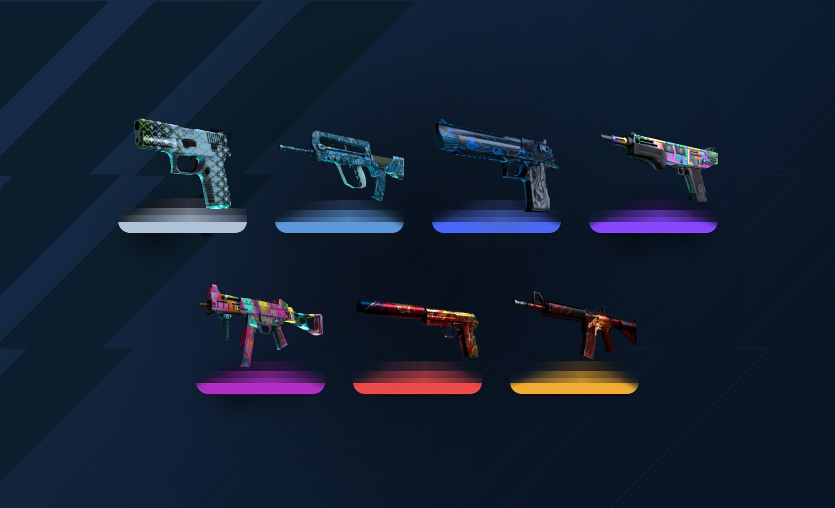
To fully grasp the Counter-Strike 2 skin economy, you must first understand the hierarchy of "Rarity Grades," which are categorized by specific colors:
White (Consumer Grade): The bottom of the ladder, mostly consisting of common weekly drops.
Light Blue (Industrial Grade): Often found in specific map collections.
Dark Blue (Mil-Spec): The entry-level tier for weapon cases (the first "rare" skins).
Purple (Restricted): Mid-range items with more detailed designs.
Pink (Classified): Very rare skins, often featuring highly polished aesthetics.
Red (Covert): The pinnacle of firearms; the rarest weapons in any case.
Gold (Exceedingly Rare): Reserved for Knives and Gloves.
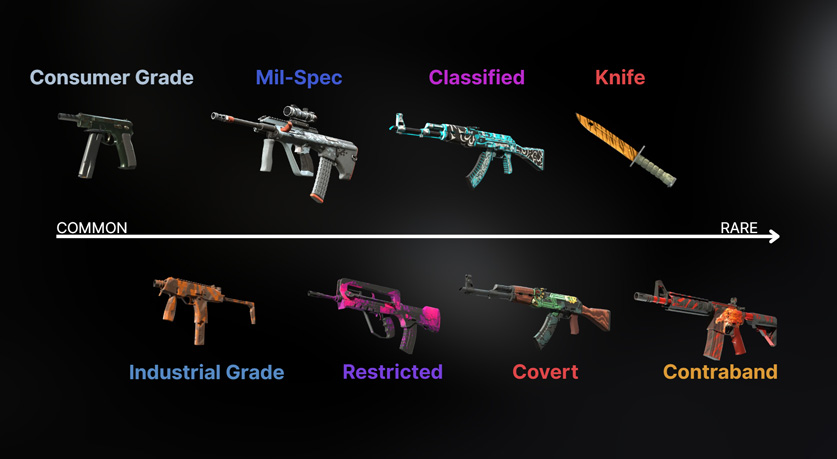
But take note: some "Red" skins can actually be cheaper than "Pink" or "Purple" ones. In reality, the skin rarities in CS2 is only one piece of the puzzle, as other factors heavily influence the final price. One of the most critical factors is the Float Value.
Float Value: The Wear Level That Changes Everything
The Float Value is one of the main factors in determining a skin's market price. It is a precise numerical value ranging from 0.00 to 1.00 that represents the skin's wear condition:
Factory New (0.00 – 0.07)
Minimal Wear (0.07 – 0.15)
Field-Tested (0.15 – 0.37)
Well-Worn (0.37 – 0.44)
Battle-Scarred (0.44 – 1.00)
As you can see, the rarity grade isn't everything; you must also consider the wear level. This explains why a rare skin with a high float, showing lots of scratches, might be worth significantly less than a Purple or Pink skin with a very low float, looking pristine.
For example, Factory New Driver Gloves | King Snake are highly coveted items, famously used by legendary pro players like dev1ce or KennyS, precisely because they are extremely hard to find in "clean" condition.
Rare Patterns: Unique Designs within the Same Skin
Another factor that nuances CS2 skin rarity is the Pattern Seed. Some skins have finishes that are applied randomly, meaning two skins of the same name can look drastically different.
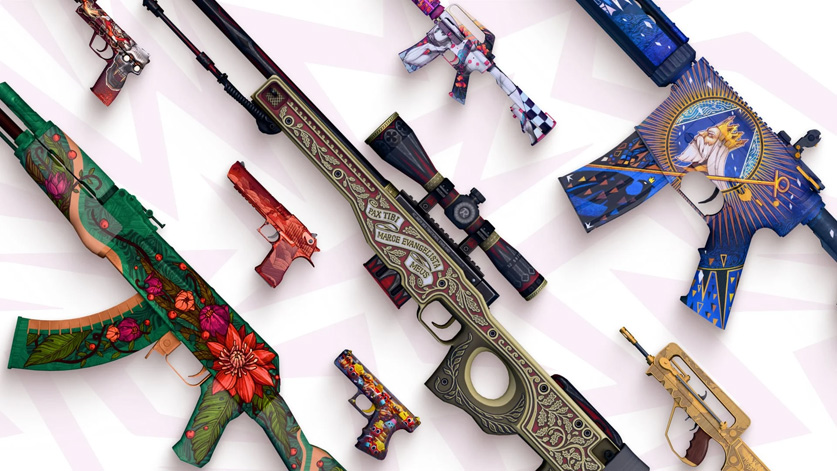
The rarer the pattern, such as the famous "Blue Gem" for Case Hardened skins, the more expensive the item becomes. In these specific cases, the base rarity grade becomes almost irrelevant compared to the uniqueness of the pattern.
StatTrak and Stickers: The Value Multipliers
The final layers of rarity in Counter-Strike 2 come from modifiers. StatTrak technology, Souvenir versions, and Stickers act as artificial rarity boosters:
StatTrak™ Technology: These skins feature a numerical LED display that tracks your kills. There is only a 10% chance of unboxing a StatTrak version of any skin.
Stickers: These are cosmetics that can be Holo, Gold, or Foil. They can significantly increase a skin’s value based on their age and rarity. For instance, a single 2014 Katowice Titan Holo sticker can be valued at over $50,000.
What Valve Doesn’t Directly Tell You About CS2 Drop Rates
When discussing rarity, it is essential to mention the actual odds of unboxing these items. Valve does not display these numbers in-game, but they are well-known within the community:
Blue (Mil-Spec): ~79.9%
Purple (Restricted): ~16%
Pink (Classified): ~3.2%
Red (Covert): ~0.64%
Gold (Knives/Gloves): ~0.26% (roughly a 1 in 385 chance).
The true value of a CS2 skin depends on four key pillars: Color Grade, Float Value, Patterns, and Modifiers (Stickers/StatTrak). A skin's price can be multiplied by 10, or even 100, if it possesses a perfect Float Value combined with rare, sought-after stickers.